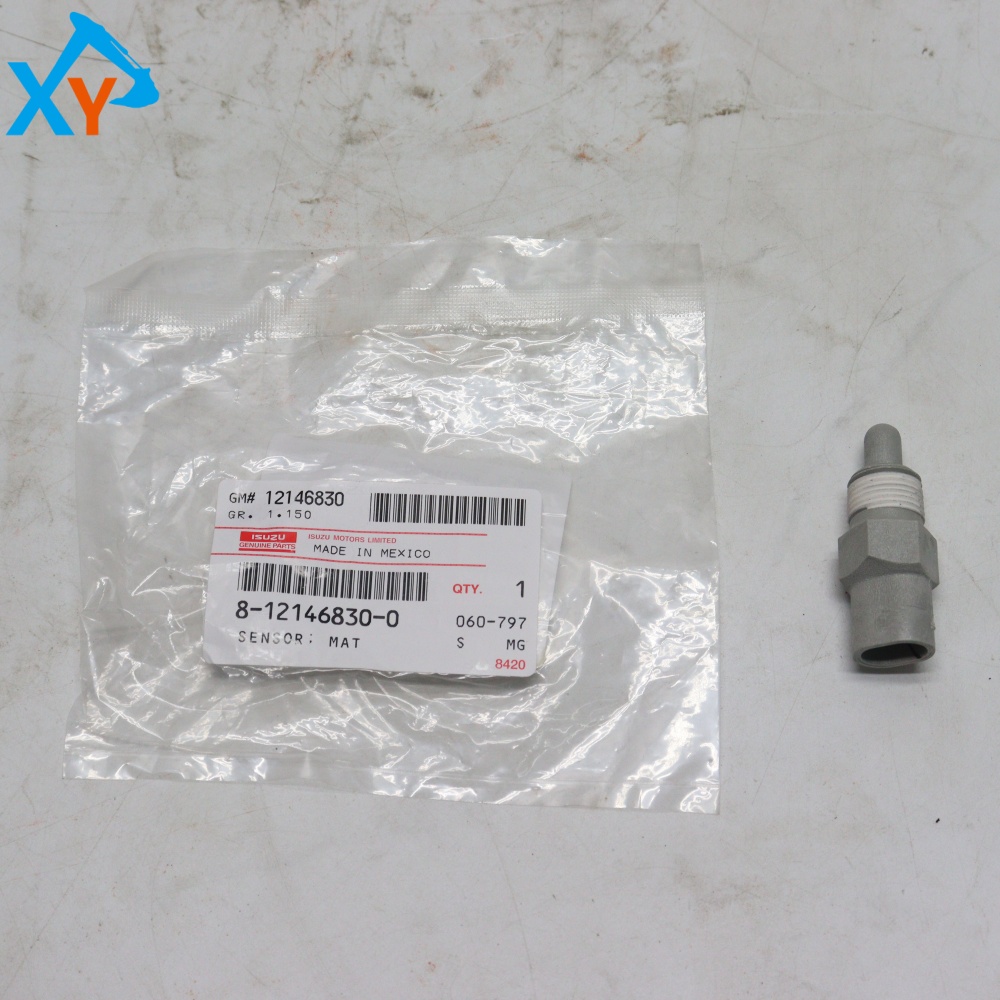
8121468300 Original Excavator Temperature Sensor for 4HK1 ISUZU Engine
| Part Number | 8121468300 |
| Part Name | Temperature Sensor |
| Engine Model | 4HK1/4JJ1/6HK1/6WG1 |
| Weight | 0.02 KG |
Product Details
Product Description
| Part Number | 8121468300 |
| Part Name | Temperature Sensor |
| Brand Name | ISUZU |
| Place of Origin | Japan |
| Delivery Time | 1-3 work days |
| Packaging Type | plastic packaging |
The original temperature sensor part number 8121468300 (also written as 8-12146830-0) is the core monitoring component of the intake system of the ISUZU 4HK1/6HK1 series diesel engines. This sensor is mainly suitable for medium-sized excavators from brands such as Hitachi, Shengang, Sumitomo, and Jiexibo equipped with 4HK1 engines, such as Hitachi ZX200-3 and ZX210-3, Shengang SK200-8 and SK250-8, Sumitomo SH200-5 and SH240-5, as well as Jiexibo JS240 and JS260 models. Its common models are often labeled as 4HK1 and 6HK1 series, which belong to thermistor type intake temperature sensors. They are usually installed near the engine intake manifold or air filter outlet to provide accurate intake temperature signals to the ECU, in order to optimize fuel injection quantity, ignition timing, and exhaust gas recirculation (EGR) control.

This product is an original intake temperature sensor that uses a negative temperature coefficient (NTC) thermistor as the sensing element. Its resistance value decreases with increasing temperature (typical working range: -40 ℃ to 150 ℃). The sensor housing is made of engineering plastic or metal material, filled with high-temperature resistant sealant, and has IP67 dust and waterproof performance, which can withstand the harsh working conditions of high temperature, high humidity, vibration, and oil pollution in the engine compartment. Its electrical interface is a 2-pin waterproof plug, which outputs a 0.5-4.5V analog voltage signal and is perfectly matched with the ECU of the ISUZU 4HK1 engine, ensuring temperature monitoring accuracy and response speed under cold start, high load, and altitude changes, directly affecting the engine's air-fuel ratio control, fuel consumption, and emission performance.
Suggest checking the sensor harness plug for looseness and oxidation every 500 working hours; Whether the shell has cracks or oil accumulation; Use a diagnostic instrument to read the intake temperature data stream and observe whether it fluctuates continuously and reasonably with changes in ambient temperature. Fault diagnosis: If there is difficulty starting the engine cold, unstable idle, increased fuel consumption, or the dashboard malfunction light is on, a multimeter can be used to measure the sensor resistance value (normally around 2.2-2.5k Ω at 20 ℃); It is also possible to disconnect the plug and measure the ECU terminal voltage (usually a 5V reference voltage) to determine if there is a fault in the circuit or sensor itself. Key points for replacement: Before replacement, disconnect the negative terminal of the battery to prevent short circuit; Use a dedicated sleeve during disassembly to avoid damaging the threads; Before installing a new sensor, apply a small amount of high-temperature resistant grease to the sealing ring and tighten it to a torque of 8-15N · m; After installation, it is necessary to connect a diagnostic tool to clear the fault code and start the engine to observe whether the data flow returns to normal.
Related Products
Call Us Now
+86 191 2466 1674
Contact Us
+86 191 2466 1674
No. 902, 9th Street, Zhuji International Machinery Parts City, No. 36, Zhuji Road, Tianhe District, Guangzhou
Request An Quote
Request An Quote